Showing posts with label Nelle Carty. Show all posts

December 7, 2008

Clearing Away the Distractions

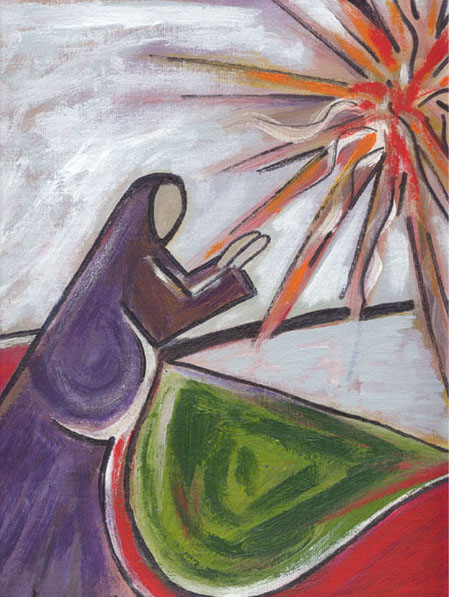
On this Second Sunday of Advent, the first reading from the prophet Isaiah (Is 40:1-5, 9-11) and the prologue to the Gospel of Mark (Mk 1:1-8) both proclaim the message to “Prepare the way of the Lord!” Sandwiched between the first reading and the Gospel, the second reading (2 Pt 3:8-14) urges Christians to repent and prepare for the Second Coming, or Parousia. The early Christians to whom Peter was writing were becoming impatient and losing hope that Christ was going to come again. This letter assured them that Christ will come again, despite the delay and unknown time of arrival. There is no missing the themes of preparation and repentance in this week’s readings. But I am left wondering how do I prepare and for what exactly am I preparing during this Advent of 2008?

The first half of the Advent season focuses on the Parousia, or the Second Coming of Christ, and then the third and fourth weeks remember when God first entered the world with Jesus’ birth. This week in spiritual direction, I explained to my director that my mind wanders frequently during prayer. The other morning, my mind drifted and I began thinking about the Second Coming. Would God come as a woman next time? What nationality/ethnicity or even socio-economic background would God assume? Then my mind jumped to, “Will I recognize ‘her’ or will I be too busy doing other things to even stop and notice?” My spiritual director said to me, “Never mind the first and second coming, what about Christ being present now?”

The opening prayer for the liturgy on this Second Sunday of Advent asks God to “open our hearts in welcome” and to “remove the things that hinder us from receiving joy.” This prayer is a prayer for the present. So as we read or hear the readings this Second Sunday of Advent, it seems that this season of preparation should not only remind us of what God did through the Incarnation or what the risen Christ will do when “she” comes again, but how we can enter into this mystery now. Often times, this means clearing away the distractions that hinder us from recognizing Christ in our midst in this very moment.

M. Nelle Carty is working on clearing away the distractions, but still very easily distracted. She is especially looking forward to the end of this academic semester when she can spend time with family and loved ones.

Image painted by Robert Hutchinson, "Advent." Used with permission. www.rogerpaintings.com


Read more!

November 28, 2008

Catholic Diversity

Although I don’t remember it being an issue when I was younger, I now marvel at the fact that I grew up with parents who had a “mixed” marriage. My mother was and still remains a Southern Republican from New Orleans, and my father maintains his roots as a New England Democrat from Worcester. My parents’ Catholic faith was one of their strongest commonalities. I find it ironic that they find common ground in the Catholic Church when the spectrum of perspectives or Catholic “parties” often seems equally—or even more—polarized than the American political system. Controversial issues, such women’s ordination, homosexual marriage and abortion, cause deep divides between members of the Catholic Church. How can Catholics, especially Catholic women from differing experiences and perspectives, worship together and support one another?

During this past presidential election, I asked my dad how he and my mom coped with having such different political views. He first responded jokingly saying, “We just agree not to talk about politics and we know that our votes cancel each other out!” When I pressed him further, though, he admitted that they alternate; they each watched the others’ political convention, they watch Fox News as well as CNN, and they read both The Houston Chronicle and The New York Times. After being in Catholic schools both as a student and an educator for more than 24 years, it seems to me that people frequently—but certainly not always—follow the “we just don’t talk about it” or worse, “we just don’t talk to one another because we know we disagree” approach. If we are all one body but with many parts, how do we go about “walking” together? The image of a three-legged race pops into my mind.

Reflecting on running an individual race versus running in a three-legged race, the partners can choose a leader, or decide to share “the decision-making.” Regardless of how the duo decides to face the challenge of advancing, they must communicate in order to move forward. This analogy obviously has limits—the Church is not in a “race” to the heavenly finish line. Yet it is easy to hear or exclaim, “We merely need dialogue between the differing parts of the body.” I agree that dialogue is needed within the members of the Church. I, however, get frustrated with people from the “other-side,” who seem completely blind to what seems so obviously “the right way” for me. Yikes, this is scary to admit!

The beauty of the Catholic Church is the inclusion of people who see and experience the One, True God in so many different ways and struggle to live in a faithful way. But what happens when the Body leans toward eliminating some of the voices of those parts and allows for only one voice to be heard? I am not suggesting that the church become a democracy, but I do think that silencing voices becomes dangerous. It is challenging to listen to the other side (a challenge that I am working on personally but not necessarily succeeding at very well). If the Body of Christ could be likened to a multi-million-legged race, how is that we could successfully move toward the Kingdom?

M. Nelle Carty has never really been a champion three-legged race contestant, but continues to have hope that one day she can improve those skills. Until then, she is concentrating on her studies in the final year of her Master of Divinity.

Picture taken from: www.sunnybreaks.org/ tag/leapfrog/


Read more!

November 1, 2008

Not So Very Perfect People…Pray for Us

Dedicated in loving memory to Fr. Robert Manning, S.J.

Whenever I lost something as a child, my mother would ask, “Have you said a prayer?” Usually I responded that I had not, and would follow this admission with a quick, “St. Anthony, St. Anthony, come around, something is lost and must be found.” Many cradle Catholics can rattle off saintly rhymes such as, “Hail Mary Full of Grace, help me find a parking space.” At the very least, most could name one or two saints you should pray to in order to pass an exam (St. Joseph Cupertino), travel safely (the controversial, yet ever popular St. Christopher), sell your house (bury St. Joseph upside down in your garden), aid with the impossible (St. Jude), and the list continues! Who are these people we pray to?

Most people were taught that we petition the saints as intercessors to pray for us to God, since they experienced the same challenges when they were living that we experience now (although I doubt Mary struggled to find city parking at night like I do in Boston). If I am calling upon a holy woman or man to pray to God for me, I assume that they are not only holy, but that they must be “Very Perfect People” (V.P.P.).


St. Teresa of Avila in the prologue to her spiritual autobiography admits she cannot find any comfort in the saints because unlike them, she has lived a wretched life, resisted God and even turned away from God after trying to dedicate her life to loving God. SAINT Teresa is one of only two women to be given the title, “Doctor of the Church” being recognized for her tremendous contribution and writings on prayer. Teresa of Avila, patron saint of headaches, exemplifies “perfectly” that the sainthood to which all baptized are called involves recognizing how far away from perfection one really is. Recognizing saints as ordinary people who had faith, prayed and lived out of their belief in God is a rich part of our tradition. Yet, in what ways can we begin to make the connection that being called to holiness is not synonymous with aiming to be a V.P.P.?

The approach of All Saints Day begs us to reflect on who the saints have been in our lives that modeled how to be ordinary, but holy people.

Tootsie Torian…pray for us…Joseph Burnett Storey…pray for us…Charley Nelle Rives…pray for us…Bob Manning … pray for us…

M. Nelle Carty is in her final year of working towards the M.Div. at the new Boston College School of Theology and Ministry. She owes a great deal to recently deceased Fr. Bob Manning, S.J., who offered her a great deal of love and support at the onset of her degree.

Read more!